
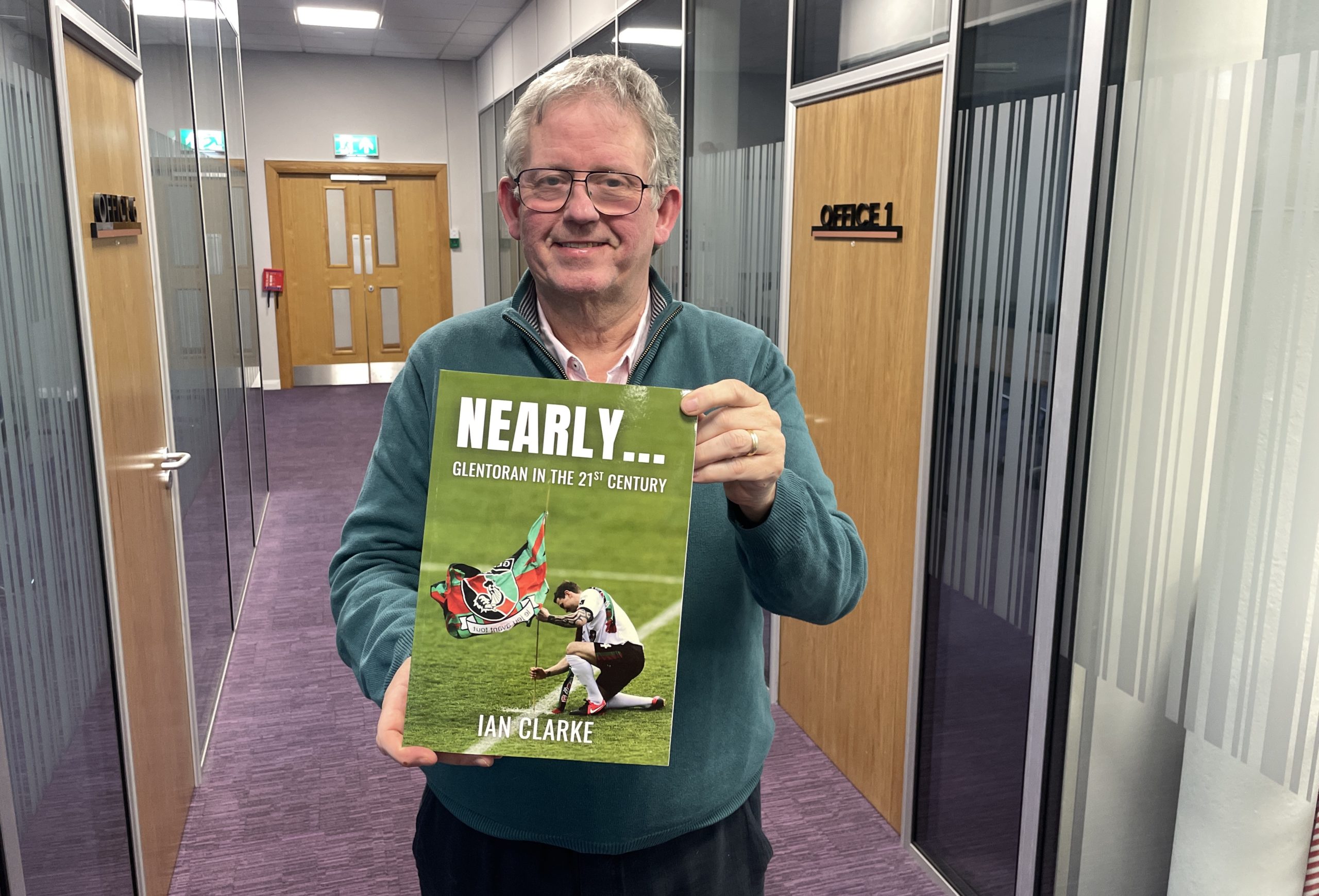
A former Glentoran director has revealed how the club came close to financial collapse, operated week to week and missed opportunities worth millions in a new insider account covering more than two decades at the heart of the East Belfast side.
Nearly…Glentoran in the 21st Century, written by Ian Clarke, draws on his time as both a director and head of media at the club to document the reality behind one of the most challenging periods in its modern history. The book details how decisions taken in boardrooms, often under pressure and with limited resources, shaped the trajectory of a club still expected to compete at the top level.
In the book, published by Excalibur Press, he sets out a picture of a club dealing with sustained instability, where long-term planning was frequently overtaken by immediate financial concerns. At times, he describes an organisation forced into short-term thinking simply to remain operational.
The book outlines how these pressures affected every part of the club, from recruitment and contracts to infrastructure and long-term strategy. However, Clarke points out a prolonged period of underperformance can’t be attributed solely to results on the pitch, pointing instead to deeper structural and financial challenges.
He explained: “When a ‘big’ club like Glentoran is unsuccessful over such a prolonged period it is clearly down to more than the performance of managers and players.”
Among the most significant moments explored in Nearly is a missed stadium development opportunity that could have transformed the club’s financial position. Plans for a new ground in East Belfast, which would have secured long-term stability and modern facilities, ultimately failed to materialise, leaving the club to continue operating within existing constraints.
The book also reveals how close the club came to a different future, with proposals involving council-owned land and major redevelopment plans that had the potential to reshape both the club and its wider community presence. Instead, those plans fell away, contributing to ongoing financial and operational pressures.
Clarke also recounts a series of incidents that exposed the fragility of the club’s position, including administrative errors and governance challenges that had immediate consequences on and off the pitch.
In one instance, he describes how a mistake regarding player eligibility led to the club’s removal from a cup competition at a time when success appeared within reach.
“We walked off the pitch that day against Newry in joint first place with Linfield and in the semi-final of an Irish Cup, a potential double. Then immediately after the game a club official comes into the manager’s office and tells me ‘I think Joe Crowe might be ineligible.’ You can imagine the sick feeling that overcame me and the staff.”
The fallout from that incident is presented as one example of how quickly circumstances could change, with decisions and errors carrying significant sporting and financial consequences.
Elsewhere, Nearly details the wider financial context in which the club was operating, including debt levels, cash flow challenges and reliance on short-term funding solutions. Clarke describes a period in which maintaining day-to-day operations often required external support, loans and continuous negotiation.
It also captures the internal pressures faced by those running the club, with committee members dealing with mounting financial obligations while attempting to preserve the club’s long-term future.
Despite these challenges, Clarke highlights periods of resilience and achievement, including cup success and competitive performances achieved under difficult conditions. Moments framed as evidence of what the club was capable of, even while operating within significant constraints.
He added: “The simple fact was that the only thing that could turn around Glentoran’s fortunes was money. Quite a lot of money. An amount of money way beyond what anyone currently involved in the club could ever hope to muster. Someone else’s money.”
The 2019 takeover by Welsh-Iranian businessman Ali Pour brought investment, full-time football and European competition. But six years on, with the league title last won in 2009 still seemingly beyond the club’s reach, Clarke’s assessment of the Pour era in the book is measured rather than celebratory, with the book including a candid interview with Ali Pour and the other major figures behind the takeover .
He added: “The simple fact was that the only thing that could turn around Glentoran’s fortunes was money. Quite a lot of money. An amount of money way beyond what anyone currently involved in the club could ever hope to muster. Someone else’s money.”
A consistent theme throughout the book is the role of supporters, whose loyalty is presented as central to the club’s survival during its most difficult periods. Clarke reflects on the level of public interest surrounding the club, noting its continued prominence within the local media landscape regardless of performance.
He said: “Glentoran, good or bad, command a level of interest matched only by Linfield. No other club comes close.”
The book also places Glentoran’s story within the wider context of East Belfast, highlighting the connection between the club and its community suggesting the club’s fortunes have long been intertwined with the area it represents, with both experiencing periods of change and challenge.
Nearly is a frank and honest detailed account of a period often viewed through headlines and speculation rather than direct experience. Drawing on internal discussions, first-hand involvement and access to the decision-making processes, Clarke provides an account of how close the club came to both success and crisis.
Readers will have the opportunity to hear from chairmen, directors, managers and players, among them Ali Pour, record appearance holder Colin Nixon and managers including Eddie Patterson and Mick McDermott, some of whom have never spoken about the club’s difficulties publicly before.
Meanwhile, Clarke, who spent his professional career in senior and board-level roles at major newspapers across Northern Ireland, England and Scotland, is clear about who the book is written for.
“Throughout the downs of the past 15 years the broad Glentoran support has shown a loyalty and commitment to its club that the club has not always deserved. This is their story and this book is for them,” he said.
Nearly: Glentoran in the 21st Century by Ian Clarke is published by Excalibur Press, priced at £20 and available now from ianclarkenearly.lovable.app